Everything below is built and running on my own self-hosted infrastructure — not a sandbox, not a template, not a one-off demo. These are five connected automations built to handle real bookings, real content publishing, real market research, and real failure alerting for my own business.
⚠️ 2026-09-15 accuracy flag: per the verified 🤖 Automation Infrastructure current state, the Cal.com Booking Intake workflow (#1 below) has zero executions ever, and Content Pipeline (#2 below) has all 4 executions stuck in
waiting, never completed. Do not present either as actively handling real bookings/publishing right now — corrected inline below.
<aside> 💡
Why this matters to you: every workflow below maps to a business outcome — hours of admin removed, faster response to real customers, zero-cost monitoring, and content/research that used to require a hire. This is the same system-building approach I'd bring to your business.
</aside>
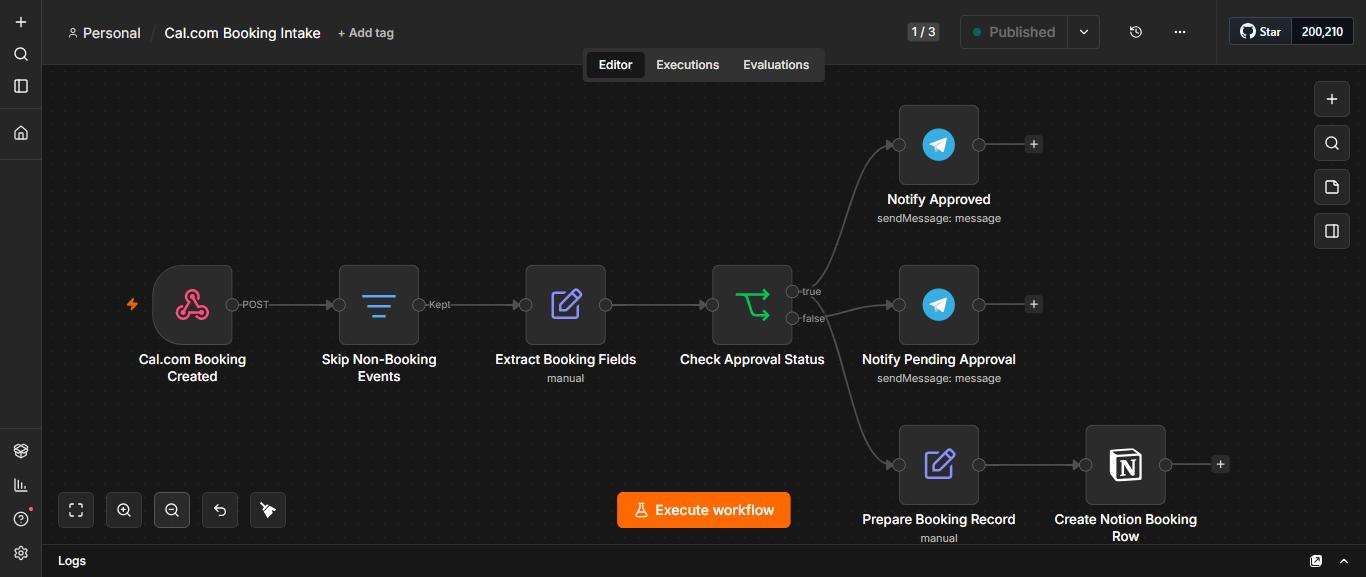
What it does (built, status unverified — see flag above): The instant someone books a call through Cal.com, this workflow is designed to capture the booking, check whether it's genuinely confirmed or still pending, route a Telegram notification accordingly, and — only for real, accepted bookings — log a clean record into a live CRM. Cal.com's test "pings" are filtered out automatically so they never pollute real data. Status: webhooked and active, but zero real executions recorded yet — treat as unverified until a real booking is confirmed to flow through it.
Cal.com Booking Intake workflow
| Business impact | Removes the manual admin of checking a booking dashboard and copying details into a CRM. No booked call is ever missed, and no test/junk data mixes in with real pipeline. |
|---|---|
| Marketing impact | Every booking driven by a piece of content or an outreach campaign becomes a trackable, timestamped CRM record the second it happens — the raw data needed to know which channels are actually converting into booked calls. |
| Sales impact | The moment a real prospect books, there's a Telegram alert and a CRM record ready before the call even starts — faster follow-up, more prepared first conversation, nothing sitting unseen in an inbox. |
| Efficiency & cost | What used to be a person checking Cal.com and manually transcribing bookings (10–15 min per booking, multiple times a day) is now instant, free, and error-free. |
What it does (built, not currently working — see flag above): Send a message to a private Telegram bot — first line as the title, everything after as the body — and the workflow is designed to reformat it for the site, send back a full preview requiring explicit approval, and on approval commit the finished post directly to GitHub, which auto-deploys the live site. Status: all recorded executions are stuck in "waiting" and have never completed — this is not currently how posts get published; the site's real publishing path is the two-step gated flow in the Blog Engine Daily Publishing OS.
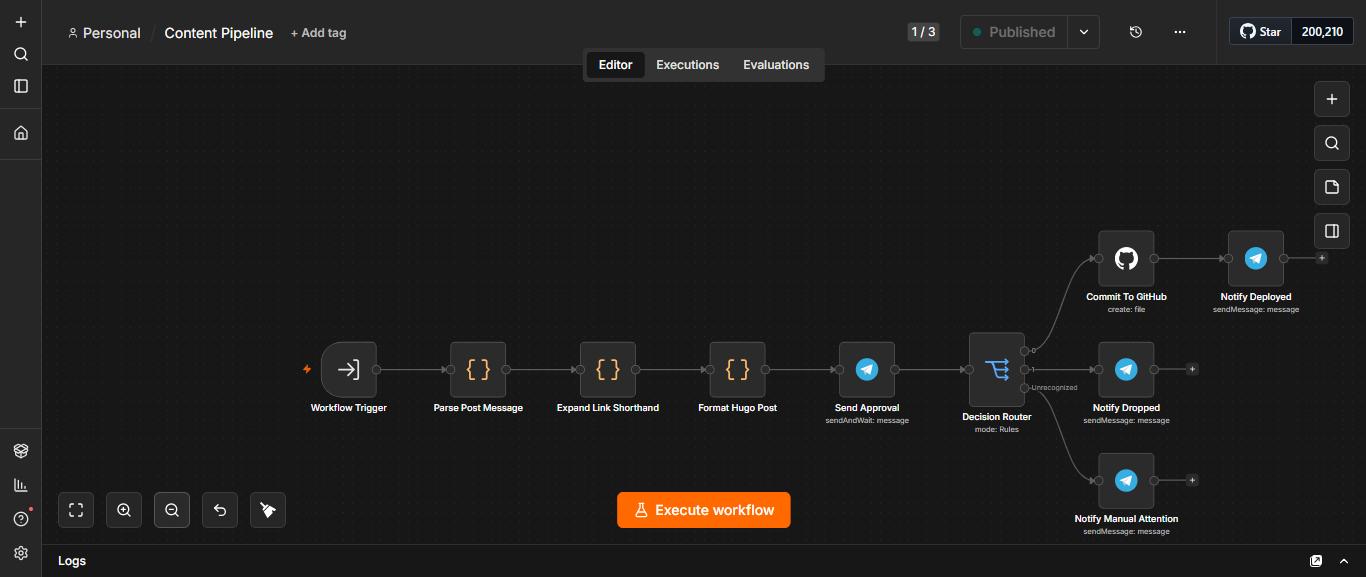
Content Pipeline workflow
| Business impact | Publishing becomes a two-message round trip from a phone — no CMS login, no developer, no laptop required to update the live site. |
|---|---|
| Marketing impact | Removes the friction that normally kills consistent content output. Idea-to-published time drops from days to minutes, which is what keeps a content cadence — and organic growth — compounding. |
| Sales impact | Proof this isn't theoretical: this exact pipeline is what published the words you're reading right now. |
| Efficiency & cost | Replaces what would otherwise be a paid CMS subscription and a manual publishing routine, entirely free, with a built-in human approval gate so nothing goes live by accident. |
What it does: Sits silently behind the other three automated workflows. The instant any of them throws an error, this fires and sends an immediate Telegram alert — the only job it has.
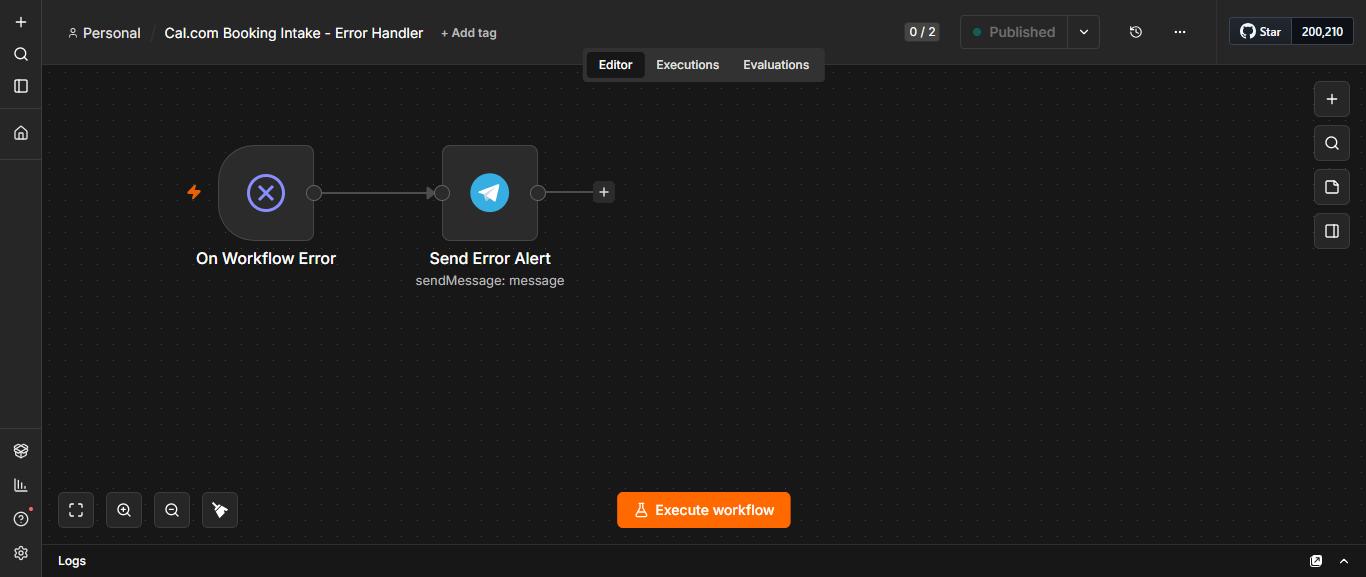
Error Handler workflow
| Business impact | Automation failures are usually silent by default. This converts a silent failure into an instant, actionable alert. |
|---|---|
| Marketing / Sales impact | A reliability story clients can trust: automation that's demonstrably monitored, not a black box that might be quietly dropping leads for days. |
| Efficiency & cost | Near-zero cost to build. The difference it buys: catching a failure in seconds instead of discovering a week of missed bookings after the fact. |